
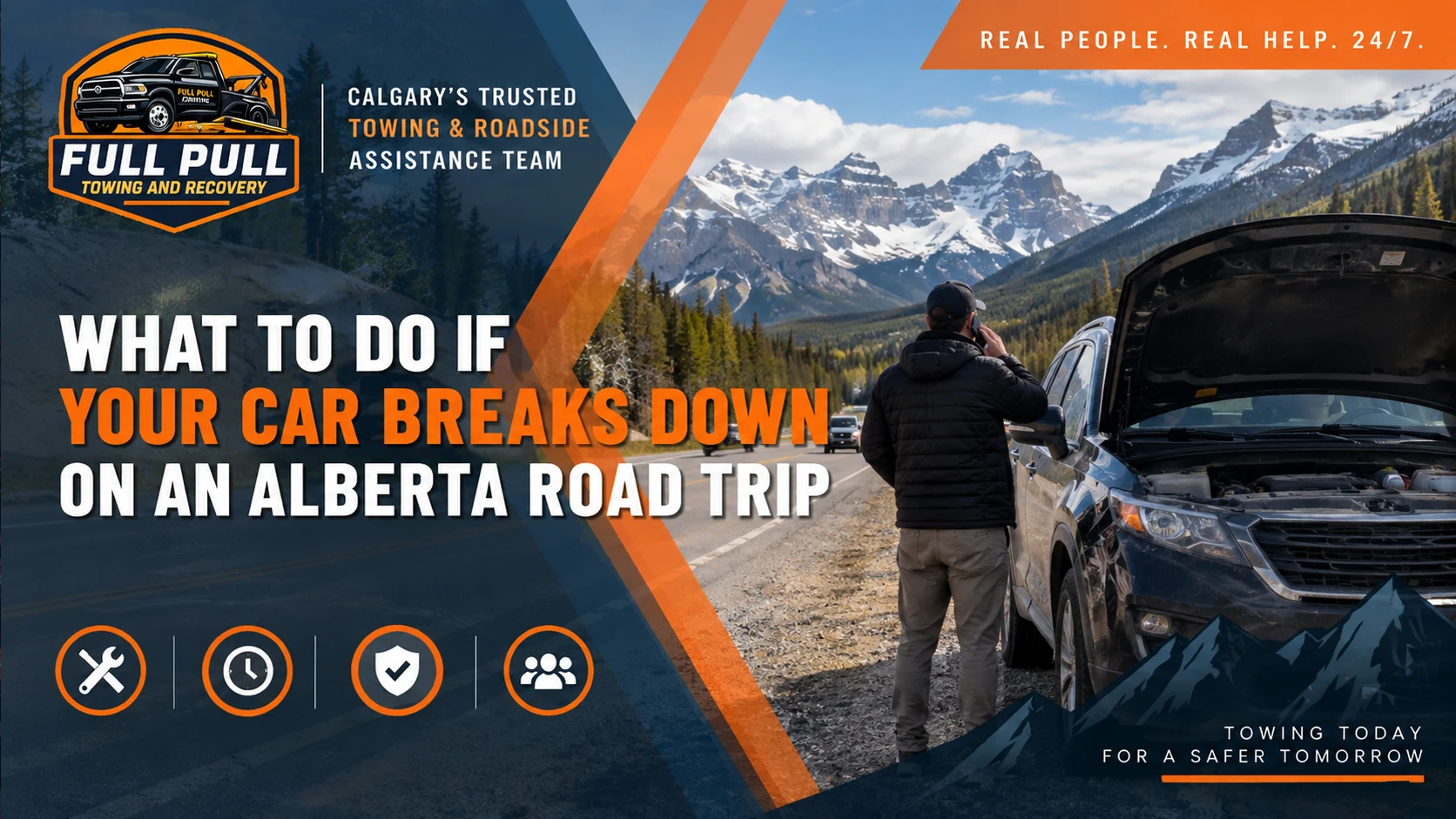
A breakdown is a safety problem before it’s anything else, and treating it in that order is what keeps you and your passengers safe. When a vehicle suddenly stops working on a road trip, especially somewhere unfamiliar, the instinct is to figure out what’s wrong right away. But the more urgent questions are simpler: can the vehicle still move, is it creating a hazard for other drivers, and is everyone inside safe where the vehicle has stopped. Getting those answers wrong, particularly on a highway, in poor weather, or somewhere far from the nearest town, is what turns an inconvenient breakdown into a genuinely dangerous one.
This guide is built around the real car breakdown Alberta drivers face: what to do immediately, how to decide whether troubleshooting it yourself makes sense, what changes during an Alberta winter, what to have ready before calling for help, and when professional roadside assistance or towing is the safer choice.
What Should You Do First When Your Car Breaks Down?
The first priority is controlling the vehicle and reducing the risk it poses to you and everyone around you, and that sequence holds regardless of what caused the breakdown in the first place. A dead battery, a flat tire, a fuel problem, and engine overheating all call for the same opening moves before they call for anything specific to the actual problem.
- Stay calm and assess what happened. Take a second to register where the vehicle actually is relative to traffic before deciding on anything else.
- Check whether the vehicle can still be steered and braked. If it can, that opens up the option of moving somewhere safer. If it can’t, don’t force it.
- If it can move, ease off the road onto the shoulder or the widest safe area you can reach. Stopping wherever the problem happened to occur, rather than at the safest nearby spot, is what turns a manageable breakdown into a hazard for other drivers.
- Turn on your hazard lights immediately, even during the day. Visibility to approaching traffic matters more than it seems like it should from inside the vehicle.
- If the vehicle can’t be moved safely, stay put. Assessing the situation with hazards on is safer than risking a collision trying to relocate a vehicle that isn’t cooperating.

How Can You Get Your Vehicle to a Safer Location?
Reaching a genuinely safer spot is worth the extra few seconds it takes, as long as the vehicle can get there under its own control.
| Better Options | Worth Avoiding |
|---|---|
| ✓A wide highway shoulder | ✕A blind corner |
| ✓A pullout or rest area | ✕The top of a hill |
| ✓A parking lot | ✕A narrow section with no real shoulder |
A stopped vehicle in one of the “worth avoiding” spots gives approaching traffic almost no warning, which is exactly why it’s worth the extra distance to reach something better when the vehicle allows it. None of this means forcing a badly damaged or unsafe vehicle to limp somewhere better. If steering, braking, or basic control is compromised, the vehicle staying exactly where it stopped, with hazards on, is the safer option over creating a new hazard trying to reach a better one.
Should You Stay in Your Vehicle After a Breakdown?
It depends on the situation, and neither “always stay inside” nor “always get out” holds up as a universal rule. What matters is whether the vehicle itself is safely positioned and whether remaining inside carries more or less risk than the alternative.
Staying inside is generally the safer choice when the vehicle is stopped in or near traffic, since a vehicle’s body offers real protection that standing on a shoulder doesn’t. Alberta RCMP has specifically advised that drivers stuck off a highway during a whiteout are safest staying inside with their seatbelt on and hazard lights running, rather than attempting to walk anywhere in near-zero visibility. Leaving the vehicle becomes the better option when staying inside presents an immediate danger, such as smoke, an unusual smell suggesting fire, or a real risk of the vehicle being struck. In those situations, move to the safest position away from the vehicle and traffic that you can reach without creating a new hazard, rather than walking any real distance along the road itself. Passengers should generally follow the same logic as the driver, moved to the side away from traffic if anyone does need to exit, and kept inside otherwise.
What Information Should You Have Ready When Calling for Help?
Giving a dispatcher accurate details up front is one of the simplest ways to speed up getting help, and it matters more on a rural Alberta highway than it does in a city where a street address alone is usually enough. A dispatcher working from vague information has to spend time asking follow-up questions before they can even start sending the right equipment, time that matters more the longer you’ve been waiting already.
- Your location as precisely as you can describe it. The highway or road number, your direction of travel, and the nearest exit, intersection, or kilometre marker all help far more than “somewhere on the highway.”
- What happened to the vehicle. Whether it simply won’t start, is making an unusual noise, has a warning light on, or has a visibly flat tire changes what equipment gets sent.
- Any hazards the dispatcher should know about. Whether the vehicle is blocking a lane, how heavy traffic is, and current weather conditions all factor into how the situation gets prioritized.
Should You Try to Fix the Vehicle Yourself?
Sometimes, but the roadside environment has to make it a reasonable idea before the mechanical question even comes up. A simple fix, like a flat tire, can be a fair thing to attempt yourself when the vehicle is in a genuinely safe position, traffic exposure is limited, the weather is manageable, and you have the right equipment and know the procedure. If you’re dealing with a flat specifically, the detailed process is covered in how to safely change a flat tire, since walking through the full procedure again here would just repeat that guide.
Plenty of situations point the other way, toward a safer call to wait. An unsafe shoulder, heavy or fast-moving traffic, poor visibility, severe weather, an unstable surface, or a repair procedure you’re not familiar with are all reasons to stop before starting, not push through. The same applies if the vehicle has damage beyond what you were expecting, or if you’re honestly not sure what caused the breakdown in the first place. Guessing at a fix for a problem you can’t identify tends to make things worse rather than better.
What Should You Do If You Break Down on an Alberta Highway?
Highway breakdowns carry risks that don’t apply the same way on a city street, mainly because of speed and distance. Traffic moving at highway speed needs far more room and time to react to a stopped vehicle than city traffic does, which is exactly why getting fully onto the shoulder and turning on hazards immediately matters more here than almost anywhere else. Warning triangles or other visibility equipment, if you can deploy them without exposing yourself to passing traffic, add another layer of warning for approaching drivers.
Distance adds its own complications on longer stretches of Alberta highway. Being far from the nearest town or service area can mean a longer wait for help and less certainty about cell coverage, which makes the basic preparation covered later in this guide, an emergency kit, a charged phone, and telling someone your route, more relevant here than on a short local trip.
What If Your Vehicle Breaks Down in Winter or Bad Weather?
Winter changes the calculation in ways worth taking seriously rather than treating as background noise. Cold temperatures alone make a breakdown riskier just by making it dangerous to be outside the vehicle for long, and AMA has reported real strain on its own response capacity during severe cold snaps, including one January stretch where battery boost calls alone spiked to 33 times normal volume and overall roadside calls topped 45,000 in under two weeks. Response times slow down across the board simply because every provider is stretched thin at once during weather like that.
Snow, ice, and poor visibility change the immediate decision too. The Government of Alberta’s own guidance for stranded drivers during a blizzard or extreme cold is to remain calm, stay inside the vehicle, and call for help, running the engine occasionally for warmth while making sure the exhaust pipe isn’t blocked with snow. None of this means every winter breakdown is an emergency. It means the margin for error is smaller, and the preparation that barely matters in July can genuinely matter in January.

What Should You Do While Waiting for Roadside Assistance or a Tow Truck?
Once help is on the way, the priority shifts from solving the problem to staying safe until it arrives. It’s easy to relax once a tow truck or roadside assistance is confirmed and on the way, but the vehicle is often stopped in the same position it was in when the problem started, which means the same risks from traffic and weather are still very much present. The waiting period deserves the same level of attention as the moment the breakdown happened, not less.
- Stay aware of approaching traffic. Even with hazards on, keep watching for vehicles that may not see you in time, especially if you’re near or outside the vehicle.
- Conserve your phone battery. You may need it again to confirm your location or answer a callback, so avoid using it for anything that isn’t necessary.
- Follow instructions from roadside or emergency personnel. If someone on scene tells you to move, wait, or stay put, that instruction reflects what they can see about the situation that you might not.
What Should You Keep in Your Vehicle for an Alberta Road Trip?
A modest, well-chosen set of supplies covers most of what goes wrong on an Alberta road trip, without needing to turn your trunk into a full survival cache.
Clothing and Weather Supplies
A blanket and warm clothing appropriate for the season, kept in the vehicle rather than packed away in luggage, matter most in exactly the situation where you’d otherwise be reaching for them from outside in the cold. The Government of Alberta’s own vehicle emergency kit guidance specifically recommends this, alongside enough food and water to be self-sufficient for a stretch longer than you’d expect to need on a normal trip.
Vehicle and Visibility Equipment
A flashlight, warning triangles or flares, and a basic tool kit cover the practical side of a breakdown. AMA’s own cold-weather guidance adds a folding shovel and gloves to that list specifically for winter travel, since digging out or working around a vehicle in snow is a different job than doing the same thing on dry pavement.
Phone, Charging, and Route Information
A way to charge your phone that doesn’t depend on the vehicle already running, and telling someone your planned route and rough arrival time before a longer trip, both matter more the farther you’re travelling from a major centre. Neither takes real effort, and both meaningfully shorten how long it takes for someone to know something’s wrong if you don’t check in.
What Should You Check Before Taking a Long Alberta Road Trip?
A short pre-trip check catches a meaningful share of the problems that would otherwise turn into a roadside breakdown later.
Tires deserve the first look, including the spare, since a marginal tire that’s fine around town can fail on a longer highway stretch at higher speed and higher temperature. Basic vehicle condition, fluid levels, battery health, and anything already flagged by a warning light, is worth a quick check too, particularly before a trip longer than your usual routine. Checking Alberta’s current road and weather conditions through 511 Alberta before you leave rounds this out, since conditions can shift meaningfully between communities on the same route, and knowing what’s ahead is part of avoiding a breakdown you could have planned around.
When Should You Call Roadside Assistance or a Tow Truck?
A handful of situations point clearly toward calling for help rather than continuing to handle things yourself. These aren’t necessarily about whether you’re capable of fixing the underlying problem. A driver who’s mechanically confident can still be looking at a situation where the roadside conditions, the location, or the extent of the damage make professional help the more sensible choice regardless of skill level.
- The vehicle can’t be safely driven. Whether that’s a mechanical issue, a wheel problem, or anything else that makes continuing risky, this is the clearest signal to stop and call.
- The roadside environment itself is unsafe. Heavy traffic, poor visibility, severe weather, or an unstable position all outweigh whatever DIY option might technically be available.
- You don’t have the equipment or experience to address the problem. Not knowing what’s wrong, or not having the right tools for what you do know, both point toward professional roadside assistance rather than improvising.
- The vehicle needs to be moved to a repair facility. Once the problem is bigger than a roadside fix, breakdown towing is what gets you and the vehicle to where it can be resolved.
What Happens to Your Vehicle After a Road-Trip Breakdown?
Most of the time, the vehicle goes to the nearest repair facility capable of handling the problem, which keeps things simple if you’re travelling somewhere close to home or the breakdown happens early in a trip. Sometimes that’s not practical, particularly if the breakdown happens partway through a longer trip and the more useful destination is your final stop rather than wherever you happen to be. Long-distance towing exists for exactly this situation, moving the vehicle to a different city or a specific destination rather than just the closest available shop.
Before the vehicle gets towed anywhere, it’s worth confirming a few details with the driver: exactly where it’s going, whether that facility can address the problem, and what happens to anything left inside the vehicle in the meantime.
Need Breakdown or Roadside Assistance in Calgary?
Full Pull Towing & Recovery operates 24/7 across Calgary and the surrounding area, offering roadside assistance Alberta drivers can count on for problems that can be resolved on the spot, along with towing for vehicles that need to go further, including 24-hour emergency towing and long-distance towing when a road trip breakdown means getting the vehicle somewhere other than the nearest shop. For an immediate roadside situation, call (587) 315-5258. For non-urgent questions or to plan ahead of a trip, reach out through the contact page instead.
Final Thoughts
A vehicle breakdown during an Alberta road trip is a safety situation before it’s a mechanical one, and the first question worth asking isn’t “can I fix this?” but “what’s the safest thing to do right now?” Getting the vehicle to a safer position, deciding honestly whether staying inside or leaving is the lower-risk option, and knowing what to have ready when you call for help all matter more than how quickly the actual problem gets solved.
Winter, distance, and unfamiliar highways all raise the stakes, which is exactly why a little preparation before a long trip pays off more than it seems like it should. When the vehicle or the situation makes handling things yourself impractical, calling for professional roadside assistance or towing is the sensible decision, not a sign the trip went wrong.
References
- Alberta Motor Association. Emergency Kit, Plugging-In Essential As Deep Freeze Approaches. ama.ab.ca: https://ama.ab.ca/news/emergency-kit-plugging-in-essential-as-deep-freeze-approaches
- Government of Alberta. Be Prepared: Emergency Kit Checklist for Your Vehicle. open.alberta.ca: https://open.alberta.ca/dataset/68800072-745c-44d0-9a41-38235c170b4e/resource/1bb58421-3cff-4ffc-987a-7f5a73b91035/download/ma-emergency-kit-checklist-for-your-vehicles-2021-04.pdf
- Government of Alberta. Blizzards, Freezing Rain, Ice Storms and Extreme Cold. alberta.ca: https://www.alberta.ca/blizzards-freezing-rain-ice-storms-and-extreme-cold
- Alberta RCMP, via Lacombe Express. Alberta RCMP: Avoid Travel and Slow Down. lacombeexpress.com: https://lacombeexpress.com/2025/12/17/alberta-rcmp-avoid-travel-and-slow-down/
- 511 Alberta. Alberta road and weather conditions. 511.alberta.ca: https://511.alberta.ca/