

The vehicle has stopped, and now there’s a decision to make: fix it yourself, or call for help. A flat tire in a parking lot and the same flat tire on a busy highway shoulder call for completely different responses. Getting it wrong has real consequences: unnecessary risk, additional vehicle damage, or more time exposed at the roadside than the situation called for. Calling for help you didn’t need just costs time.
This guide walks through the same question you’re facing right now, DIY fix or call roadside assistance in Calgary: what’s reasonable to handle yourself, when professional help makes more sense, and when the vehicle should be towed instead.
Should You Fix a Roadside Problem Yourself or Call for Help?
A DIY fix can make sense when the problem is minor, you know what you’re doing, you have the right tools, and you can work from a genuinely safe location. When any of those things is uncertain, professional roadside assistance is usually the better choice.
When a DIY Fix May Be Reasonable
A handful of conditions need to line up before attempting a fix yourself makes sense: the vehicle is somewhere safe, away from traffic and with good visibility; you have the correct tools for the specific problem; you’re familiar with the task rather than guessing at it; the problem is one you can identify with confidence; and the vehicle will genuinely be safe to drive once you’re done, not just temporarily moving. When all of that lines up, a flat tire in a well-lit parking lot or a jump-start with tools you know how to use can be a reasonable DIY fix.
When Calling Roadside Assistance Makes More Sense
Professional help becomes the better option once any of those conditions isn’t met: the location is exposed to traffic, visibility is poor, the weather has turned, you don’t have the right tools or experience, or you’re not sure what’s wrong. It’s also the safer call whenever there’s a real risk that an attempted fix could cause further damage or injury, or when the vehicle wouldn’t be safe to drive even after a temporary fix.
Professional roadside assistance exists for exactly these situations, arriving with the tools and experience to resolve the problem on the spot, or to determine that towing is the more appropriate next step.
Get Professional Roadside Help When DIY Isn't the Safe Option
Not every roadside problem needs to be diagnosed or repaired on your own. If the vehicle is stranded, the location isn’t safe, or you’re genuinely unsure what’s wrong, professional assistance is a reasonable next step regardless of how the problem started.
If you’re dealing with a roadside problem in Calgary right now, call for immediate assistance from Full Pull Towing & Recovery. For questions or to arrange service ahead of time, you can reach out through the contact us page instead.
What Should You Consider Before Attempting a DIY Roadside Fix?
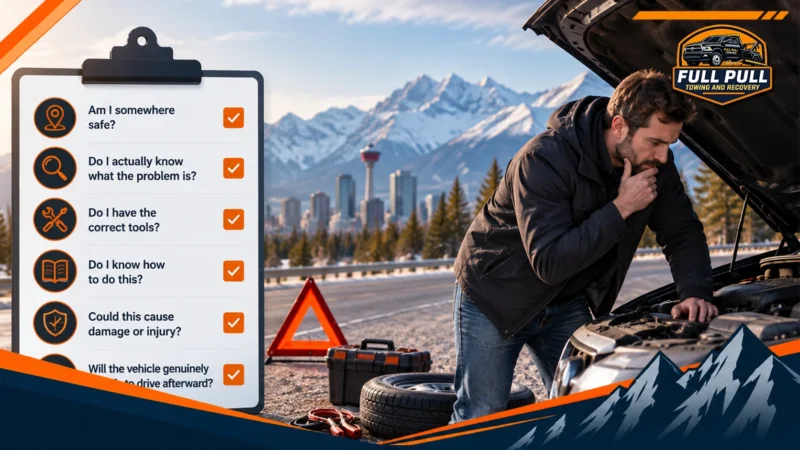
A short mental checklist, run through before touching the vehicle, usually makes the decision clear.
- Am I somewhere safe? If the vehicle is exposed to traffic, or there’s no safe way to work around it, that alone is usually reason enough to call for help instead.
- Do I actually know what the problem is? Guessing at a diagnosis and hoping a simple fix resolves it often makes the situation worse, not better.
- Do I have the correct tools? A spare tire and jack for a flat, jumper cables for a dead battery: having the right equipment for the specific problem matters more than general handiness.
- Do I know how to do this? Owning the right tools doesn’t mean the task itself is one you’re comfortable performing correctly.
- Could this cause damage or injury? This matters most around batteries, electrical systems, an overheating engine, brakes, or anything involving lifting the vehicle.
- Will the vehicle genuinely be safe to drive afterward? A temporary fix that gets the vehicle moving again isn’t the same as one that makes it roadworthy.
Which Common Roadside Problems Can You Handle Yourself?
Applying that checklist to a few common situations makes it more concrete. A flat tire, a dead battery, an empty fuel tank, and a lockout are among the most common roadside problems drivers run into, and each one plays out differently depending on where the checklist above lands for your specific situation.
Flat Tire
Changing a flat tire can be a reasonable DIY task in a safe, level location with a working spare, a jack, and some familiarity with the process. On a busy shoulder, in poor visibility, or without a full-size spare, a professional flat-tire service change is the safer option, and can also confirm the tire is genuinely safe to drive on afterward, not just temporarily inflated.
Dead Battery
A jump-start can be a reasonable DIY fix for a driver who’s comfortable with the correct cable order and has another vehicle or a portable jump pack available. Connecting cables incorrectly, or jump-starting a battery that’s damaged or leaking, can create a real safety risk, which is where a battery boost service becomes the better call.
Running Out of Fuel
Running out of fuel looks like a simple problem, but walking to a gas station isn’t always a practical or safe response, particularly in poor weather, on a rural stretch of road, or from an isolated location. Emergency fuel delivery avoids that gap entirely.
Locked Keys Inside the Vehicle
A car lockout can be tempting to solve with an improvised tool, but that approach risks damaging the door panel, window seal, or lock mechanism, sometimes at a higher cost than the lockout itself. Professional vehicle lockout assistance gets you back in without that risk.
When Is a Vehicle Problem Too Serious for a DIY Fix?
A few situations fall outside what a roadside fix can reasonably resolve, regardless of tools or experience.
- An unfamiliar mechanical or electrical problem. If you can’t identify what’s actually wrong, there’s no reliable way to know whether a simple fix will resolve it or mask a more serious issue.
- An overheating engine. A vehicle’s cooling system is pressurized, and opening the radiator cap before the engine has fully cooled can release hot coolant and steam capable of causing severe burns. Continuing to drive an overheating vehicle also tends to make the underlying damage worse.
- Steering or brake problems. These systems directly control your ability to steer and stop the vehicle, which puts them well outside routine roadside troubleshooting.
- Significant vehicle damage. Collision damage or a major mechanical failure often means the vehicle isn’t safe to continue driving at all, which points toward towing rather than a roadside repair.
Is It Safe to Work on a Car on the Side of the Road?
Sometimes, but the vehicle’s location and the weather affect that answer as much as the mechanical problem itself does. The same repair that’s perfectly reasonable in a quiet parking lot can become genuinely dangerous on a busy shoulder or in poor conditions, which is why traffic and weather deserve their own look before you decide.
How Traffic Changes the Risk
A stopped vehicle on a busy road is exposed to passing traffic in a way that’s easy to underestimate from inside the vehicle. Alberta’s roadside worker safety rules require drivers approaching a stopped roadside vehicle with flashing lights, including tow trucks, to move over to the far lane when it’s safe to do so. If they can’t safely move over, they must slow to 60 km/h or the posted speed limit, whichever is lower. A broken-down vehicle without the same visibility or protection can be at even greater risk.
How Calgary Weather Can Affect a Roadside Situation
Cold temperatures, snow, ice, and reduced visibility all make roadside work slower and more dangerous than it would be in mild conditions, and a Calgary winter can turn a manageable fix into a genuinely risky one. If the weather has turned, or visibility is already poor, that’s a reasonable point to stop attempting a fix and call for help instead, even if the problem itself would otherwise be a reasonable DIY task.
In our dispatch experience, call volume spikes hardest on the first genuinely cold morning of the season, not necessarily the coldest day of the year. Drivers adjust to a gradual cold snap, but a sudden overnight drop catches a marginal battery off guard before anyone’s had a chance to think about testing it.
When Do You Need Roadside Assistance Instead of a Tow?
Roadside assistance and towing solve different problems within the same vehicle breakdown, and knowing which one you need saves time.
Roadside assistance is usually enough for a flat tire, a dead battery, running out of fuel, a lockout, or another problem that can genuinely be resolved on the spot. Towing becomes necessary once the vehicle can’t be safely driven, the underlying problem can’t be resolved at the roadside, continuing to drive risks additional damage, or the vehicle has significant damage. When roadside assistance determines the vehicle needs to be moved rather than repaired on the spot, breakdown towing picks up from there, and for situations that can’t wait, 24-hour emergency towing covers exactly this gap.
What Should You Do If You Are Stranded and Unsure What to Do?
When you can’t confidently tell which category your situation falls into, a simple sequence works better than guessing.
- Get to the safest available location you can reach.
- Assess the situation without putting yourself at risk to do so.
- Avoid attempting a repair you don’t understand.
- Determine whether the vehicle can safely continue, even briefly.
- Contact professional roadside assistance once you’ve done the above.
- Give the provider your location and a clear description of the vehicle and the problem.
How to Decide: DIY Fix or Professional Roadside Assistance?
Bringing the factors above together into one table makes the decision easier to apply in the moment.
| Consideration | DIY May Be Reasonable | Professional Help Is Better |
|---|---|---|
| Location | Safe, away from traffic | Exposed or unsafe |
| Problem | Simple and understood | Unknown or serious |
| Tools | Correct equipment on hand | Required tools unavailable |
| Experience | You know the procedure | You're unsure |
| Vehicle condition after | Safe to drive | Unsafe to drive |
| Weather | Reasonable conditions | Severe, cold, or poor visibility |
| Risk | Low | Significant |
If most of your situation lands in the right-hand column, that’s a reasonably clear signal to call for help rather than start the repair.
How Can You Prepare for a Future Roadside Emergency?
A little preparation before a breakdown happens makes the in-the-moment decision easier.
- Keep basic emergency equipment in the vehicle. A spare tire, jack, jumper cables, a portable inflator, and a small emergency kit cover a reasonable range of common problems.
- Know your vehicle before you need to fix it. Your owner’s manual covers details specific to your vehicle, like tire-changing procedure or jump-start precautions, that generic advice can’t.
- Know who to contact for roadside help. Having a roadside assistance provider’s number saved ahead of time saves real time during an actual emergency, when looking it up is the last thing you want to do.

Frequently Asked Questions
Get Professional Roadside Help When DIY Isn't the Safe Option
Not every roadside problem needs to be diagnosed or repaired on your own. If the vehicle is stranded, the location isn’t safe, or you’re genuinely unsure what’s wrong, professional assistance is a reasonable next step regardless of how the problem started.
If you’re dealing with a roadside problem in Calgary right now, call (587) 315-5258 for immediate assistance from Full Pull Towing & Recovery. For questions or to arrange service ahead of time, you can reach out through the contact us page instead.
Final Thoughts
Not every roadside problem needs professional help, and not every one is a reasonable DIY task either. The difference comes down to safety, location, weather, your own tools and experience, and whether the vehicle will genuinely be safe to drive once you’re done. A flat tire in a safe, well-lit spot is a different situation than the same flat tire on an exposed highway shoulder in bad weather, even though the fix itself is identical.
When any of these factors is uncertain, or the vehicle has already shown it can’t safely continue, calling for professional roadside assistance or a tow is the sensible choice over pushing ahead alone. Saving a bit of time or money is rarely worth the risk of getting it wrong at the roadside.
Refrences
- Government of Alberta. Roadside worker safety. alberta.ca: https://www.alberta.ca/roadside-worker-safety
- Calgary Police Service. Road Trip Safety. calgarypolice.ca: https://www.calgarypolice.ca/public-safety/crime-prevention/travel-and-vehicle-safety/road-trip-safety.html
- CAA Magazine. Protecting Your Vehicle from the Heat. digital.caamagazine.com: https://digital.caamagazine.com/road-trip-2026/protect-vehicle-from-heat
- CAA-Quebec. How to safely jump-start a car battery. caaquebec.com: https://www.caaquebec.com/en/advices/maintaining-a-vehicle/boosting-a-car-battery-follow-the-guide
Get Professional Roadside Help When DIY Isn't the Safe Option
Not every roadside problem needs to be diagnosed or repaired on your own. If the vehicle is stranded, the location isn’t safe, or you’re genuinely unsure what’s wrong, professional assistance is a reasonable next step regardless of how the problem started.
If you’re dealing with a roadside problem in Calgary right now, call for immediate assistance from Full Pull Towing & Recovery. For questions or to arrange service ahead of time, you can reach out through the contact us page instead.